For creative agencies and production houses, the primary obstacle in generative media isn’t a lack of motion; it is a lack of control. While the novelty of “text-to-video” captured initial curiosity, it quickly hit a wall within professional environments where brand fidelity and visual consistency are non-negotiable. A prompt that results in a visually stunning 4-second clip is useless to a client if the character’s facial structure shifts between shots or if the product’s geometry warps as it rotates.
The industry is currently shifting toward a “static-first” workflow. In this model, the creative team locks in the visual “ground truth” through high-fidelity image generation before introducing temporal variables. By establishing a rigid reference point, agencies can bypass the unpredictable hallucinations of pure text-to-video models. This transition from a single generative gamble to a controlled motion pipeline is where the real value for client delivery lies.
The Fidelity Trap: Why Pure Text-to-Video Struggles with Brand Standards
The fundamental flaw in many early AI video workflows is the “fidelity trap.” When a model is asked to generate both the subject and the motion simultaneously from a text prompt, it often prioritizes movement over anatomical or architectural accuracy. For an agency tasked with creating a social media spot for a luxury skincare brand, “generative luck” isn’t a viable strategy. If the bottle’s label flickers or the liquid texture looks like molten plastic, the asset is discarded.
Text-to-video models often ignore specific brand geometry and color palettes in favor of what the model perceives as a “cool” cinematic effect. This creates a production bottleneck. A team might spend hours rolling the metaphorical dice, hoping for a seed that respects the brand’s visual identity.
This is why we are seeing a move toward Image-to-Video (I2V) as the professional standard. By starting with a locked image, the AI is no longer responsible for “inventing” the brand’s aesthetic on every frame; it is instead tasked with animating a pre-approved environment. This separates the creative direction of the asset from the technical execution of the motion.
The Static Anchor: Establishing Visual Ground Truth via MakeShot
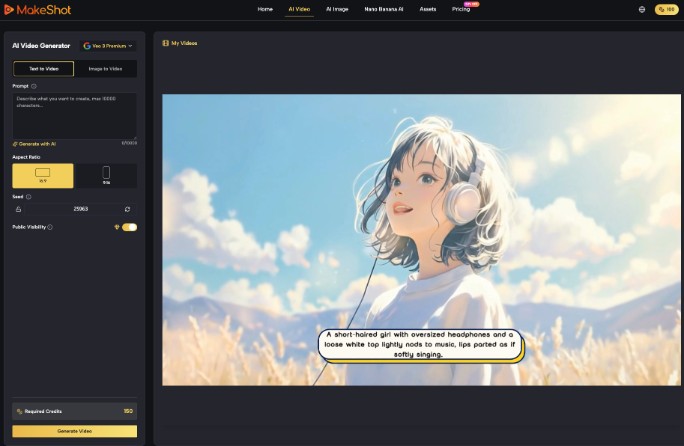
To achieve a reliable output, the workflow begins with the creation of a high-resolution “anchor” image. This is where tools like MakeShot become critical. Unlike generic generators that might skew toward a specific artistic style, using a dedicated image engine allows creators to define lighting, character features, and environmental details with granular precision.
Establishin this ground truth is the most labor-intensive part of the modern AI pipeline. It involves iterating on composition and texture until the “hero” frame meets the creative director’s standard. Once that frame is “locked,” it acts as a constraint for the motion model. This prevents the “pixel mush” often seen in direct-to-video outputs, where the background details bleed into the foreground as the camera moves.
Using Nano Banana AI in this stage allows for the micro-adjustments necessary for professional work. Whether it is adjusting the glint on a metallic surface or ensuring a character’s eyes are the correct shade of blue, these tweaks must happen at the static level. Trying to fix these details in post-production video editing is often five times more expensive and significantly more time-consuming than getting the initial source image right.
Motion Vector Mapping: Translating Compositions into Cinematic Action
Once the source image is finalized, the process moves into motion synthesis. This is a technical handover where the static composition is fed into an AI Video Generator to interpret the scene’s depth and potential for movement.
The goal here is not just to “make it move,” but to define “motion intent.” Professional workflows generally categorize motion into two buckets:
- Camera Movement: Panning, zooming, or tracking shots that move the viewer’s perspective while keeping the subject relatively static.
- Subject Movement: Intentional action within the frame, such as a person walking or a car driving through a landscape.
When utilizing the MakeShot ecosystem for these transitions, the model uses the source image as a map. By analyzing depth maps and edge detection from the static asset, the generator can estimate how objects should occlude one another as the camera shifts. For instance, if you have a foreground character and a background mountain, a well-mapped motion workflow ensures the character moves at a different rate than the mountain, preserving the parallax effect.
However, there is a delicate balance in the “seed” consistency. If the model is too strictly tethered to the original image, the motion may appear stiff or “puppet-like.” If it is given too much freedom, the temporal consistency breaks. Practical judgment is required to determine when to allow the model to regenerate certain pixels to accommodate new angles and when to force it to stick to the original reference.
The Limits of Temporal Consistency: Where the Workflow Still Breaks
Despite the advancements in I2V technology, it is important to reset expectations regarding current limitations. We are not yet at a stage where “one-click” professional video is a reality across all use cases.
The most prominent hurdle is the “Physics Problem.” Generative models still struggle with complex physical interactions. If a character in an AI-generated scene picks up an object, the interaction between the hand and the item often results in merging textures or vanishing digits. Similarly, fluid dynamics—such as pouring a glass of water or waves crashing—remain highly unpredictable. In these instances, we cannot yet rely on AI to handle complex choreography without significant manual oversight.
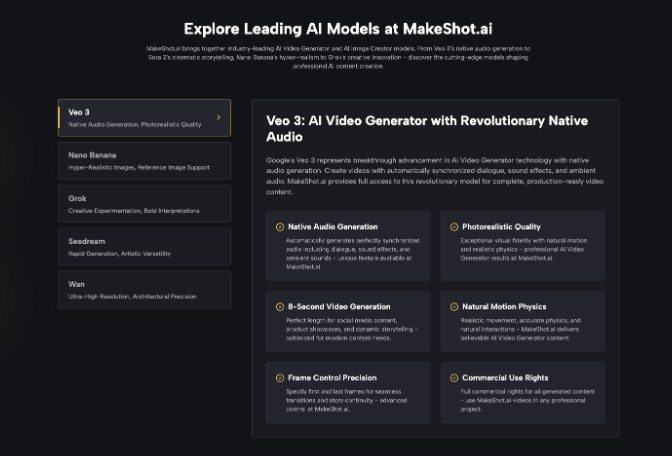
Another limitation is temporal degradation. While the first two seconds of a generated clip might maintain incredible fidelity, there is a visible drop in quality after the 4-second mark in most current models. The “memory” of the model starts to fade, and the details of the original Nano Banana AI source image begin to drift. For longer sequences, agencies are currently forced to stitch together multiple shorter clips, which introduces a new set of challenges in color matching and pacing.
Pipeline Optimization: Scaling High-Fidelity Video for Client Delivery
For an agency, the commercial viability of AI video depends on its scalability. Traditional CGI or live-action shoots are expensive because of the labor and equipment involved. AI video should be cheaper, but if a team spends three days trying to get a single 5-second clip to look “right,” the cost-benefit disappears.
A key strategy for optimization is the “reject threshold.” High-output teams know when a shot is fixable and when it requires a complete regeneration of the source image. If the motion is warping the subject’s face beyond recognition, no amount of prompting will save it; the team must go back to the image phase and perhaps simplify the composition to give the video generator a cleaner path.
Operationally, these AI outputs are rarely the final product. Most professional pipelines integrate AI-generated clips into traditional Non-Linear Editing (NLE) software like Premiere Pro or DaVinci Resolve. Here, editors apply traditional color grading, add sound design, and use mask-and-blend techniques to hide any minor AI artifacts.
The strategy is to treat the AI as a high-end stock footage generator that is custom-tailored to the brand. You aren’t asking the AI to be the director, the cinematographer, and the editor all at once. You are using it to generate the “raw footage” that fits a very specific, pre-determined visual brief.
Establishing a Commercial Workflow
- Phase 1: Concepting. Use rapid image generation to establish the “vibe” and get client buy-in on the visual style.
- Phase 2: The Anchor. Use high-fidelity image tools to create the hero frames for each scene.
- Phase 3: Motion Pass. Run the images through the video synthesis engine, testing different motion scales to find the sweet spot between movement and stability.
- Phase 4: Post-Production. Clean up the 4-second “bursts,” stitch them together, and apply the brand’s final color lut.
By following this process-driven approach, the unpredictability of generative AI is tamed. We move away from the “magic box” mentality and toward a tactical, production-savvy environment where the static image remains the king, and motion is its loyal, albeit sometimes temperamental, servant. The future of AI in video isn’t about replacing the artist; it’s about providing a more efficient way to translate a static vision into a moving reality without losing the brand’s soul in the process.